
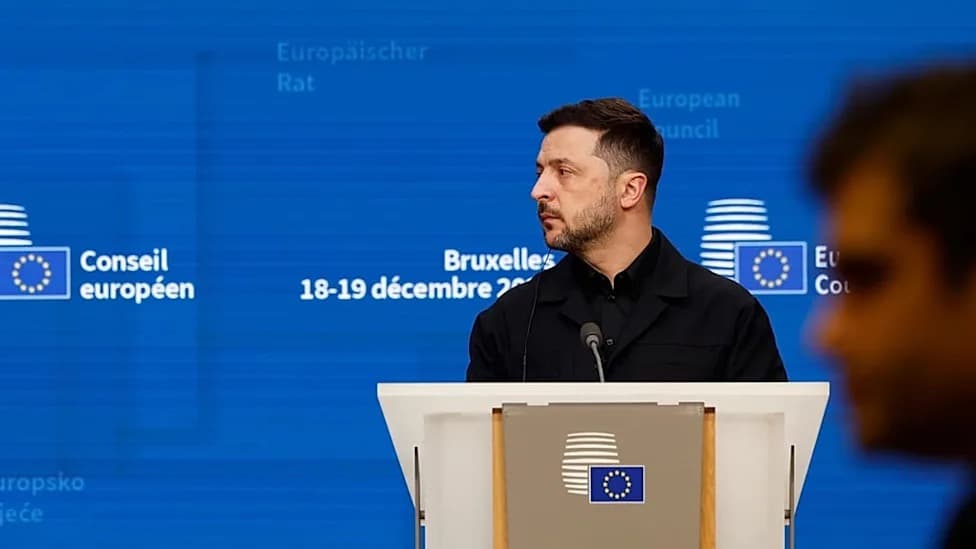
The European Commission says its 90 billion euro support loan for Ukraine remains sufficient for the moment, even as several member states argue it will not be enough to cover the country's mounting costs.
The loan, agreed interest free, is set to be paid out in two equal instalments of 45 billion euros across 2026 and 2027. So far Ukraine has received 3.2 billion euros in budgetary aid and 8.35 billion euros in military aid under the programme. President Volodymyr Zelensky has said Kyiv needs far more, and has asked the EU to front load some of next year's allocation into this year as Russian strikes on infrastructure drive costs higher. Ukraine's defence ministry alone is facing a shortfall estimated at 23 billion euros.
Belgium's veto still looms over the frozen assets option
Sweden, the Netherlands, Spain and Poland are pushing to revive an earlier plan to draw on roughly 210 billion euros in immobilised Russian central bank assets, arguing the 90 billion euro loan will not cover what Ukraine actually needs. Swedish Foreign Minister Maria Malmer Stenergard said doing so was both fair to Ukraine and fair to taxpayers.
The Commission itself once championed that approach, before dropping it in December 2025 after Belgium, which hosts most of the frozen assets through the Brussels based clearing house Euroclear, raised objections. Belgian Prime Minister Bart De Wever has called the scheme legally risky and warned it could damage Euroclear's business, a concern sharpened by a lawsuit Russia's central bank has filed against the clearing house to block any loan drawn from its money. With EU budget talks already under way, officials in Brussels are reluctant to reopen such a divisive question for now, and expect Western allies outside the bloc, including Norway with a pledged 7.86 billion euros for 2027, to cover roughly a third of Ukraine's remaining needs.