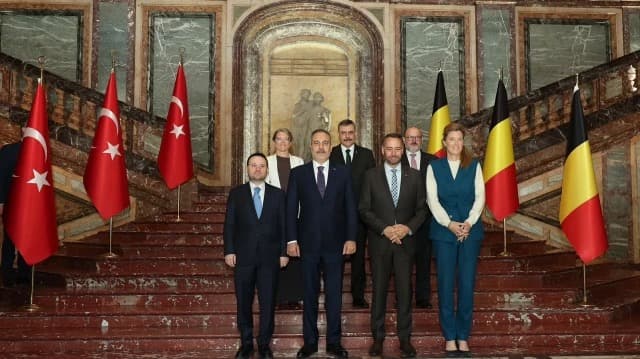
Fidan Rounds Out Brussels Trip With NATO and EU Meetings as Turkey Touts Deepening Ties
After a ministerial session with Belgian counterparts, Turkey's foreign minister spent his three day visit meeting NATO's Mark Rutte and the EU's Kaja Kallas, with talks ranging from the Black Sea to Libya's maritime claims and the war in Ukraine.
Turkish Foreign Minister Hakan Fidan closed out a three day visit to Brussels with separate meetings alongside NATO Secretary General Mark Rutte and European Union foreign policy chief Kaja Kallas, extending a trip built around the fourth joint ministerial session between Turkey and Belgium on Tuesday. He also addressed the European Policy Centre think tank and met with business representatives during the stay.
Fidan said Turkey and Belgium's relationship was deepening across all areas and described the ministerial talks as concrete steps built on mutual trust and shared interests, pledging that Turkey would keep working with its Euro-Atlantic partners on peace, security and stability. He pointed to Belgium's large scale economic mission to Ankara in May as evidence the relationship has already moved beyond diplomatic statements into business ties.
Black Sea and Libya on the agenda with Kallas
The conversations with Rutte and Kallas ranged well beyond the bilateral relationship with Belgium. Kallas and Fidan discussed tensions in the Black Sea as well as Turkey's maritime boundary agreement with Libya, a deal that has long strained relations between Ankara and several EU member states in the eastern Mediterranean. Fidan's broader schedule in Brussels also touched on the war in Ukraine, conflicts in the Gulf, the standoff in the Strait of Hormuz and the Palestinian issue.
The breadth of that agenda underlines what Belgian officials said a day earlier when they called Turkey indispensable to European security: a NATO ally whose diplomatic reach into the Black Sea, the Middle East and North Africa gives Brussels and its institutions reason to keep a direct line open, even as formal ministerial contact between the two countries had lapsed for a decade before this week.