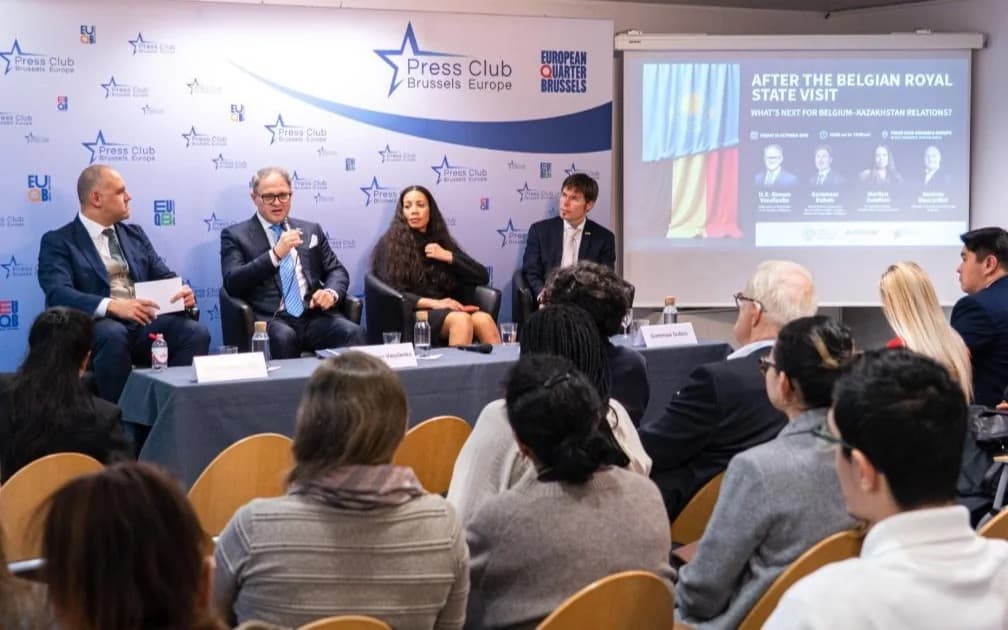
Brussels Takes Stock of a Deepening Kazakhstan Partnership After the King's Historic Visit
Diplomats and officials gathered at Press Club Brussels Europe to assess what comes next after King Philippe and Queen Mathilde's first state visit to Kazakhstan produced 40 agreements and a roadmap through 2029, with trade between the two countries having nearly tripled in under a decade.
Diplomats, officials and analysts gathered at Press Club Brussels Europe on October 24 to take stock of Belgium's relationship with Kazakhstan, less than two weeks after King Philippe and Queen Mathilde completed the first state visit by a Belgian monarch to the Central Asian country. Kazakhstan's ambassador to Belgium, Luxembourg and the EU, Roman Vassilenko, joined a Belgian foreign ministry official and a foreign policy adviser to the European Council president to discuss what the visit means for the countries' partnership and for the wider EU Central Asia relationship.
The royal visit, which ran from October 11 to 14, brought a roughly 110 member delegation, including senior Belgian officials, 25 business executives and academic representatives, first to Astana, where King Philippe met President Kassym Jomart Tokayev, and then to Almaty. The two heads of state adopted a joint statement and the countries' foreign ministries signed a cooperation roadmap running through 2029. In total, 40 documents were announced during the trip, including 16 commercial agreements and 22 agreements between universities and research institutions.
A trade relationship that has nearly tripled in a decade
The joint statement singled out the Trans-Caspian International Transport Route, better known as the Middle Corridor, as a strategic priority connecting Asia and Europe, alongside critical minerals, agriculture, healthcare, education, advanced technologies, digital infrastructure and artificial intelligence. Belgium has invested more than 15 billion dollars in Kazakhstan since 2005, and more than 100 Belgian companies and joint ventures now operate there. Trade between the two countries reached 765 million euros in 2025, up from around 220 million euros in 2016, while trade between Kazakhstan and the EU as a whole totaled about 45 billion dollars last year.
The Brussels briefing follows a string of recent contacts between the two sides, including President Tokayev's visit to Brussels in June and last year's Central Asia EU summit in Samarkand. A visa free travel agreement between Kazakhstan and the EU is due to take effect on November 1, a detail officials at the briefing flagged as one of the more immediate, visible outcomes for ordinary travelers even as the larger commercial and infrastructure agreements take years to fully play out.