
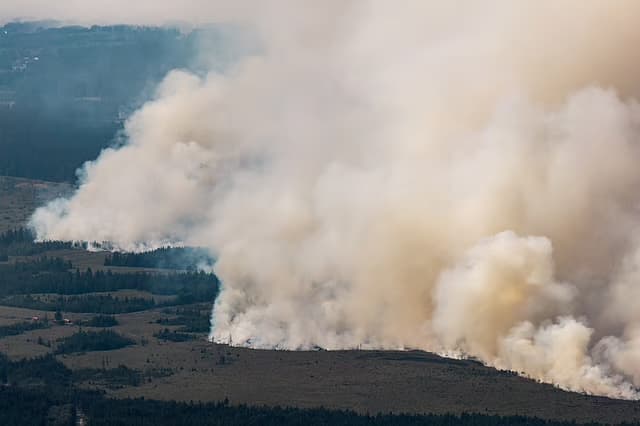
The wildfire burning through Belgium's High Fens nature reserve has grown to around 30 square kilometres, making it one of the worst the country has seen in recent history, as fires elsewhere in Europe turned deadly over the weekend.
On the Greek island of Salamina, west of Athens, two people were killed on Sunday when strong winds pushed a fast moving blaze through the village of Peristeria. A second fire broke out nearby in the Selini area, forcing coast guard and firefighting vessels to evacuate beachgoers from the coastline. Around 260 firefighters, 15 ground teams, 10 aircraft and eight helicopters were sent to fight the two fires, after the island had already been placed under a high wildfire risk warning with near gale force winds. Fire Brigadier General Vasileios Vathrakogiannis said the conditions let the blaze reach dangerous proportions and spread toward homes within about seven minutes.
Belgium's biggest fire in living memory
Back in Belgium, the fire in the High Fens has now far surpassed the 2011 blaze that had previously stood as the country's worst wildfire on record, at close to 14 square kilometres. Liege provincial governor Herve Jamar said more than 250 emergency personnel are now involved, including over 100 Belgian and German firefighters, alongside police, military and civil protection staff, with helicopters flown in by Belgium's federal police and the Netherlands.
Nicolas Yernaux, a spokesperson for the Public Service of Wallonia, said this fire is a different scale of problem than usual because the soil itself is so dry. Rene Dahmen, chief engineer at the Department of Nature and Forest, said crews were still struggling on Sunday to reach parts of the blaze, with a line of fire at least a kilometre long slowly advancing toward a municipal forest on the eastern flank, which he called the current priority.
Around 600 residents of Waimes and Butgenbach, near the German border, were ordered to evacuate on Saturday as shifting winds pushed smoke through the area, with a nearby gymnasium opened to take people in and tourists also told to leave. Interior Minister Bernard Quintin said firefighters had managed to stop the fire spreading west toward the German town of Monschau, though German authorities said on Sunday the flames were still only about 1.5 kilometres from the border. In scenes that made clear how local the response has become, farmers from both sides of the border filled tanker trucks with water from a nearby lake to bring to crews on the ground.
Europe answers the call
Belgium has activated the European Union's civil protection mechanism to bring in reinforcements from abroad. EU Crisis Management Commissioner Hadja Lahbib wrote on social media that the High Fens are burning and that Belgium is not facing it alone. Sweden has sent two water bombing aircraft, while three helicopters, two from the Netherlands and one from the Czech Republic, have also joined the operation.
The fire follows weeks of unusually hot, dry weather, with temperatures in Belgium reaching around 37 degrees Celsius on Friday. The High Fens' mix of heathland and peat bog has made the blaze especially hard to contain.
Belgium is far from the only country dealing with fire this summer. In southwestern France, firefighters battling a blaze in the pine forests of the Landes region reported no major flare ups overnight, according to regional prefect Gilles Clavreul, though the fire has already burned an estimated 17 square kilometres and forced roughly 650 people from their homes. It is the third major wildfire to hit the Landes forests this summer alone. Britain has also seen wildfires break out during the same run of hot weather.