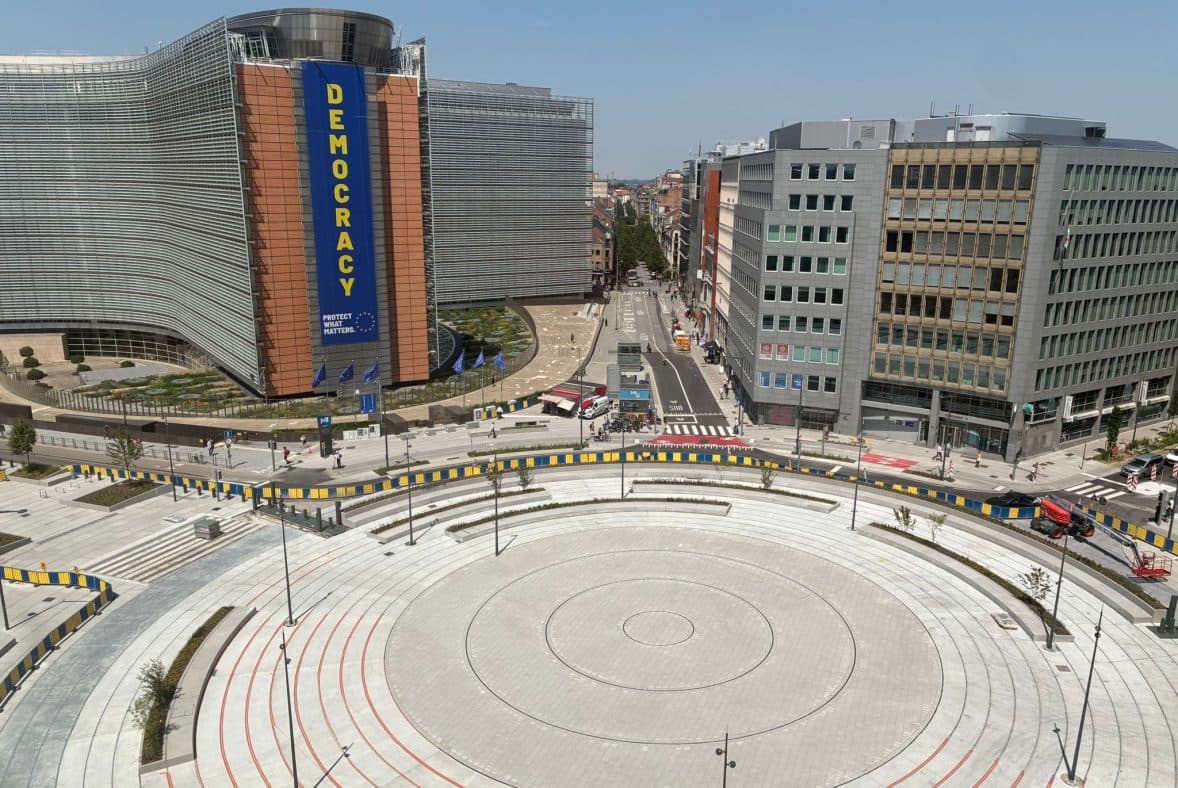
A long awaited redesign of Schuman Square, the roundabout at the symbolic heart of Brussels' EU quarter, has drawn sharp criticism after its signature feature was never built, leaving a wide expanse of bare paving with little shade.
The project set out to turn the traffic clogged roundabout into what planners called an urban agora, a calmer and greener meeting place at the center of the neighborhood that hosts the European Commission and Council.
Traffic through the square has indeed been reduced, and the space has been repaved in smart grey stone. But the centerpiece of the original design, a large steel canopy topped with a planted green roof, was never constructed.
The canopy, designed by the Brussels firm Brut together with the Danish firm Cobe, was meant to provide shade over a square that sits above a railway station, a metro line, and a road tunnel, engineering constraints that made building on the site especially difficult.
Without it, critics have taken to calling the finished square Europe's largest frying pan, a nod to the wide, sun exposed concrete plaza that greets commuters and EU officials arriving through Schuman.
Pascal Smet, the former Brussels minister for mobility who launched the project back in 2015, said he felt disappointed, angry and sad at how it turned out.
The shortfall reflects years of political deadlock and rising costs that dogged the scheme as it moved from ambitious concept to a scaled back reality, a familiar pattern for major public works in the Belgian capital.
For a square meant to symbolize a modern, welcoming EU quarter, the unfinished canopy has instead become a visible reminder of how difficult it can be to turn Brussels planning ambitions into finished projects.