
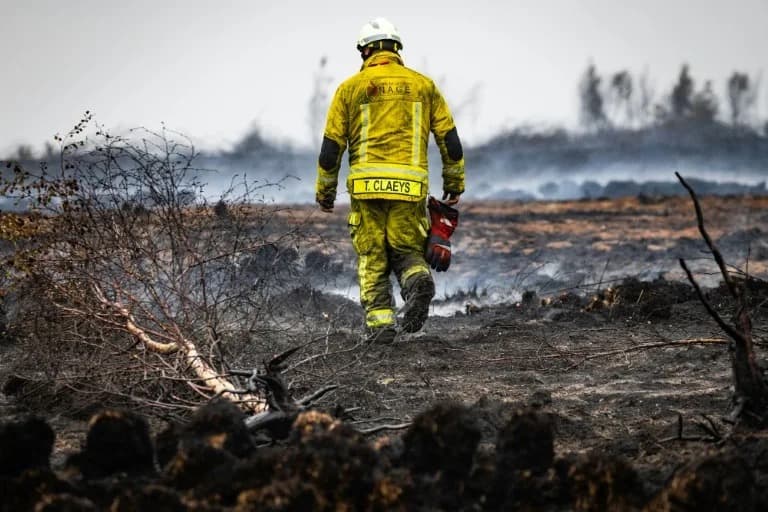
Emergency crews say they have fully encircled Belgium's largest wildfire in more than a hundred years, closing the ring around the High Fens nature reserve after working through the night to hack a line through boggy terrain near the German border.
Tony Hosmans, spokesman for the crisis cell coordinating the response, said the fire that has been burning since Friday has been contained and should no longer be able to spread outward. He cautioned, though, that the job is far from finished. "The affected area is extremely large and there are numerous flare-ups that we need to combat both on the ground and from the air," he said.
The blaze has now burned through around 3,000 hectares of peatland and pine forest, an area roughly half the size of Manhattan. Hundreds of firefighters have been on the ground continuously, and water-bombing aircraft sent from Norway, Germany, Sweden and the Netherlands have taken part in the operation, though low cloud cover has grounded the planes on some days.
Why officials fear "zombie fires"
Fire chief David Covens said the reserve's thick peat layer is what makes this blaze so hard to finish off. "The fire is burning in the peat, so it is actually underground, sometimes quite deep," he said. Peat can smolder for long stretches out of sight and resurface elsewhere, a pattern firefighters call a zombie fire, which can undermine tree roots and cause them to collapse without warning.
To catch those hidden hot spots before they break through the surface again, crews have been flying heat-sensing drones over the burned area. Officials say putting the fire out for good, rather than simply containing it, will likely take weeks or months of soaking rain and continued monitoring.
The High Fens reserve was scorched by a similarly severe fire back in 1911, during another stretch of unusually hot, dry weather. This year's blaze has already overtaken that historical benchmark, and now ranks as the most destructive wildfire recorded in Belgium.