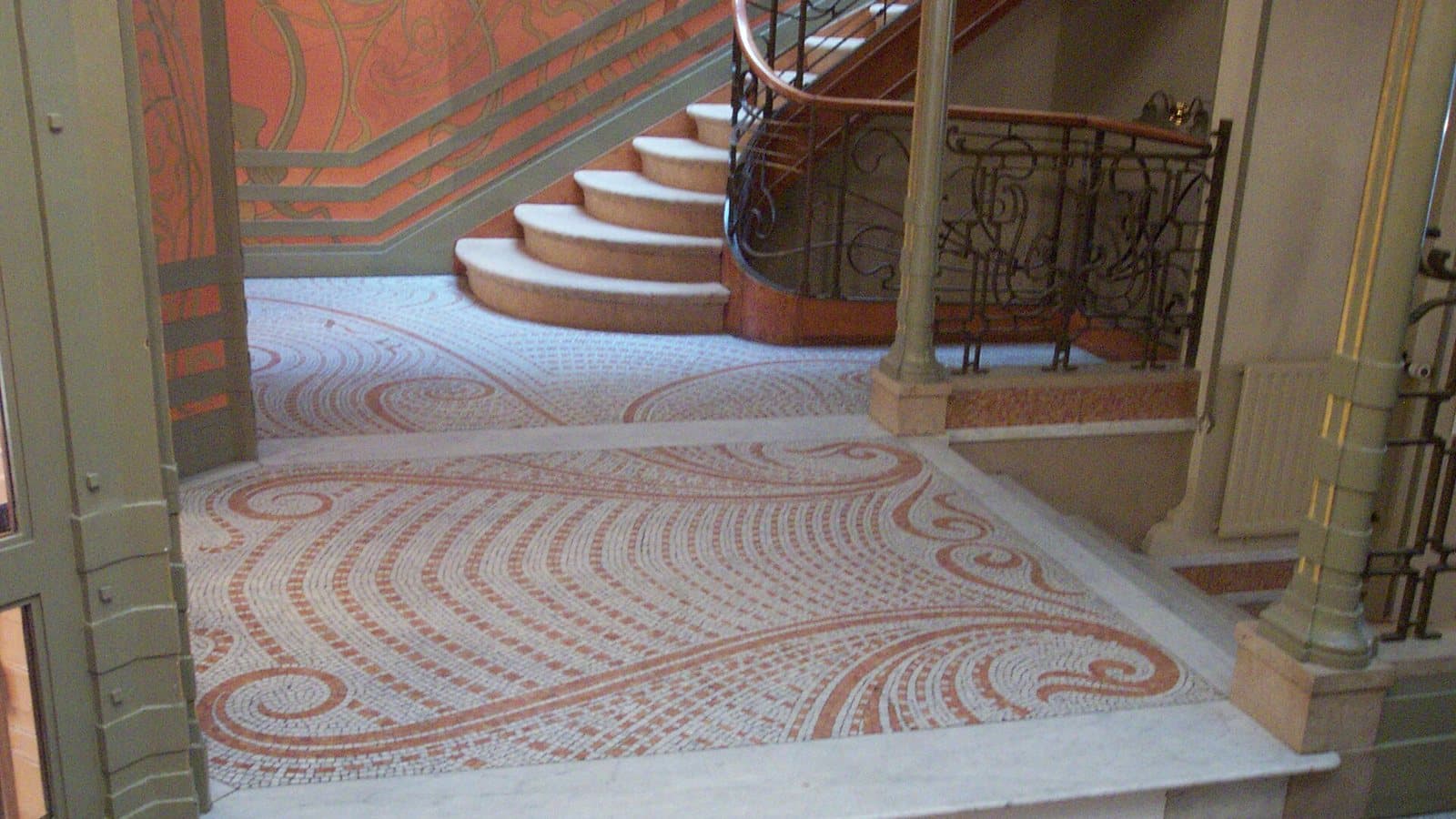
The Hotel Tassel, completed in Brussels in 1893 to a design by Victor Horta, is usually described as the first Art Nouveau building. What made it new was not decoration but plan: an open, top lit stair hall at the centre of a narrow town house, iron used visibly as structure rather than hidden, and the ornament following the structure rather than applied over it. Within a decade the language had spread across Europe.
Four Horta houses in Brussels were inscribed on the UNESCO World Heritage list in 2000: the Hotel Tassel, the Hotel Solvay, the Hotel van Eetvelde and Horta's own house and studio, now the Horta Museum. They are private scale buildings, and the listing is unusual for concentrating on domestic architecture rather than on a monument.
The building that is missing from that list is the one the city is still asked about. Horta's Maison du Peuple, a curved iron and glass headquarters for the Belgian workers party completed in 1899, was demolished in 1965. The demolition provoked international protest, entered architectural history as a byword for postwar municipal vandalism, and gave the practice of clearing nineteenth century Brussels for offices the nickname it has carried ever since.
A great deal else went the same way in the decades either side of it. Whole streets of Art Nouveau and eclectic houses were cleared for road schemes and office blocks, and the survivors are scattered rather than grouped, which is why visiting them means crossing the city rather than walking a quarter.
The reversal, when it came, was thorough. Brussels now has some of the stricter heritage protection in Europe for the period, a dense programme of guided openings, and a restoration sector with real expertise in the specific problem of iron, glass and mosaic. The city protects what it has with the particular energy of somewhere that knows exactly what it lost.